
Semiconductors are no longer just enablers of consumer electronics—they’ve become strategic assets. As global tensions escalate and technological leadership becomes a matter of national security, export controls are emerging as powerful policy levers. Nowhere is this more visible than in the semiconductor industry. Recent U.S. export controls targeting advanced chips and equipment have fundamentally altered the semiconductor landscape, especially in relation to China. Leading-edge logic chips at 5nm and below, AI processors with high throughput interconnects, and advanced EUV lithography tools are now tightly regulated. The implications for both chipmakers and system integrators are profound. According to recent industry benchmarks, U.S. restrictions imposed in 2022 and tightened in 2023 have successfully curtailed China’s access to critical silicon components needed for high-performance computing and generative AI models. For example, NVIDIA’s A100 and H100 GPUs—essential for training large-scale AI models with hundreds of billions of parameters—can no longer be shipped to China without a specific license. Meanwhile, China’s domestic chipmakers, such as SMIC, are accelerating efforts to manufacture below the 14nm node without access to EUV tools—a feat that stretches the limits of DUV immersion lithography. Current data suggests limited yields and increased power inefficiency at these nodes, putting them at a disadvantage in performance-per-watt metrics—critical in mobile and AI inference workloads. Key Implications for the Industry Supply Chain Fragmentation: Global supply chains are being forced to bifurcate. Companies are re-evaluating foundry partners and regional manufacturing strategies to ensure geopolitical risk mitigation. Increased Onshoring: U.S., EU, and Japanese governments are incentivizing domestic semiconductor production. The CHIPS Act alone unlocks $52B in subsidies, aiming to restore leading-edge logic capacity stateside. AI Slowdown in China: Without advanced GPUs, China’s ability to train large foundational models is constrained, potentially impacting global competitive dynamics in AI-driven industries such as biotech, finance, and defense. R&D Divergence: With restricted access to cutting-edge tools and IP, Chinese firms may redirect efforts toward alternative architectures (e.g., RISC-V) or pursue indigenous innovation—albeit with longer time horizons. Toolmakers in the Crosshairs: ASML, Lam Research, and Applied Materials face long-term revenue uncertainty as regulatory constraints limit their addressable markets in Asia. These developments underscore a critical shift: technological sovereignty is now a national priority. The semiconductor industry sits at the nexus of innovation and geopolitics, and firms that fail to read this new terrain risk obsolescence—regardless of how advanced their process nodes or AI architectures may be. According to recent filings, TSMC’s 3nm ramp is well underway, with Apple and AMD already designing for these nodes to achieve better performance-per-watt ratios. In contrast, efforts to replicate similar capabilities in restricted markets could be years behind, even under ideal conditions. The race for semiconductors is not just about who can build smaller transistors. It’s about who controls the infrastructure, the talent pipelines, and the regulatory frameworks that define what’s strategically permissible—and what’s not. How will your organization adapt to a semiconductor ecosystem defined as much by policy as by process? #Semiconductors #Geopolitics #AIChips #SupplyChainResilience #CHIPSAct #TechPolicy #AdvancedManufacturing
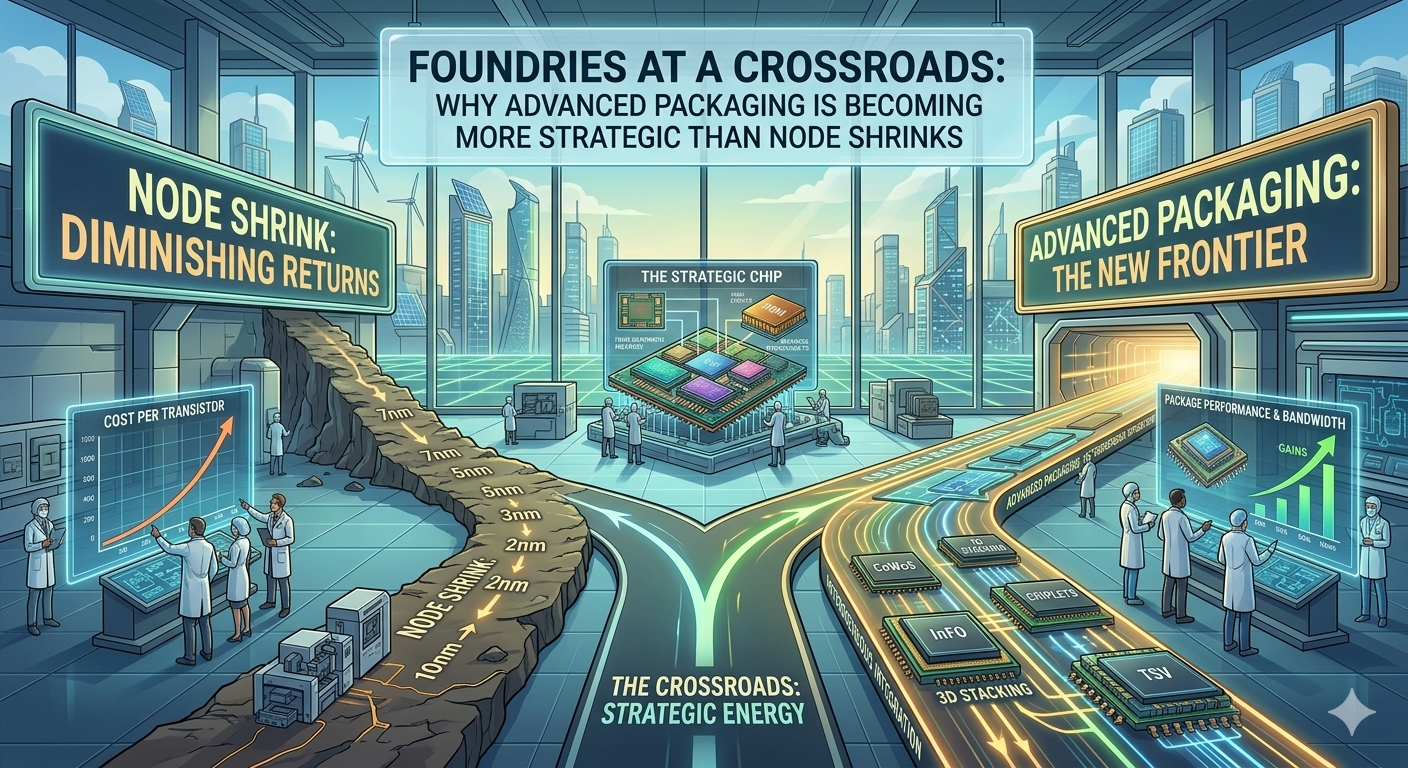
Foundries at a Crossroads: Why Advanced Packaging Is Becoming More Strategic Than Node Shrinks
For decades, the semiconductor industry followed a clear path: shrink the node, boost performance, reduce power. But that roadmap, defined by Moore’s Law, is hitting a wall—not just physically, but economically. At 3nm and below, the cost per transistor is no longer dropping significantly. Design complexity has skyrocketed. Yields are pressure points. Meanwhile, foundries and fabless players are rewriting the playbook—not around smaller nodes, but smarter integration. Enter advanced packaging. Once a back-end consideration, packaging is now a front-line differentiator. Chiplets, 2.5D, 3D stacking, and hybrid bonding are reshaping how performance and power efficiency are achieved. Why This Matters Now Advanced packaging is enabling performance gains that rival—and sometimes exceed—those from full-node shrinks, without the escalating cost curve. According to recent industry benchmarks, chiplet-based designs can reduce time-to-market by 30% and lower development costs by up to 50% compared to traditional SoC approaches at leading-edge nodes. Apple’s M-series chips, AMD’s EPYC line, and Intel’s Foveros architecture are all leveraging these techniques to combine IP blocks fabricated on different process nodes. The results? Higher bandwidth, lower latency, better thermal profiles—without waiting on the next process technology to mature. Key Insights Node economics are shifting: Below 7nm, each shrink delivers diminishing returns in cost-per-transistor and power efficiency. Chiplets unlock modular scaling: Reusing validated IP across multiple products reduces verification overhead and speeds deployment. Vertical integration is back: Leading foundries are investing in packaging capabilities to offer end-to-end design and manufacturing services. Thermal and interconnect challenges are design drivers: Packaging now plays a pivotal role in managing power density and data flow. Supply chain implications: Outsourced packaging and testing (OSAT) vendors are racing to keep up, but leading-edge capabilities are consolidating among top-tier foundries. Market Implications Current data suggests that by 2027, more than 50% of advanced node chips will use some form of heterogeneous integration. The shift is real—and irreversible. Foundries that once competed on nanometers now compete on packaging roadmaps. TSMC’s CoWoS and InFO, Intel Foundry Services’ EMIB and Foveros, and Samsung’s X-Cube are all signaling a broader pivot: packaging is no longer a commodity—it’s the next frontier of innovation. This evolution will reshape semiconductor competition, capital allocation, and design strategies. It also creates new opportunities for EDA players, substrate suppliers, and thermal engineers to claim a more strategic seat at the table. We’re seeing the dawn of a new paradigm where performance per watt per mm2 is optimized not just through silicon scaling—but through architectural ingenuity and packaging intelligence. Final Thought As Moore’s Law slows, More-than-Moore accelerates. The question isn’t just who can build the smallest transistors—but who can assemble the smartest systems. Is your organization investing in packaging innovation as aggressively as it once did in node shrinks? #Semiconductors #AdvancedPackaging #Chiplets #MooresLaw #FoundryStrategy #HeterogeneousIntegration #AIHardware
The Semiconductor Slowdown Nobody Predicted: Inventory, CapEx Pullbacks, and the New Cycle Reality
For much of the past decade, the semiconductor industry rode a wave of hypergrowth. AI workloads, hyperscaler demand, mobile expansion, and automotive digitization drove insatiable appetite for compute. Foundries pushed toward bleeding-edge nodes—5nm, 3nm, even eyeing 2nm—without hesitation. And then, suddenly, the brakes slammed on. Current data suggests we are entering a semiconductor slowdown few expected. The culprits? Swelling inventories, CapEx pullbacks from hyperscalers and cloud providers, and a structural rebalancing of demand. But beneath the surface, the story is more nuanced—and more consequential. A Supply-Demand Shock While AI model sizes are still ballooning—GPT-4 reportedly has over 1.7 trillion parameters—actual hardware deployment is lagging. Latency and power bottlenecks remain stubborn at the edge and data center. Meanwhile, consumer electronics and automotive segments are digesting a surplus of chips stockpiled during the pandemic-era shortages. According to recent industry benchmarks, utilization rates at leading foundries like TSMC and Samsung have dropped below 80% at advanced nodes. Even 5nm capacity is underbooked, and 3nm uptake is behind forecast. CapEx guidance from hyperscalers like AWS and Meta has been revised downward in consecutive quarters. The result? A cooling cycle that no node advancement can heat up—at least for now. Structural Shift or Temporary Stall? It’s tempting to view this as a cyclical downturn. After all, the semiconductor industry is notorious for boom-bust swings. But this time, structural factors may be at play. The shift toward chiplet-based architectures and domain-specific accelerators (DPUs, TPUs, FPGAs) is decoupling demand from traditional monolithic SoCs. Cloud-native AI inference is increasingly being optimized for efficiency over raw power—putting pressure on general-purpose GPU demand. Furthermore, geopolitical risk—in particular, U.S.-China export controls—is introducing friction into global fab utilization. Chinese hyperscalers are pulling back on orders, while Western players hedge bets across multiple foundries and geographies. This fragmentation adds uncertainty to capacity planning and ROI on advanced node investments. Key Implications CapEx Rationalization: Foundries and hyperscalers are slowing new investment in leading-edge nodes. Expect delays in 2nm ramp and diversification toward mature nodes (28nm, 65nm) for analog and automotive. Inventory Glut: Excess channel inventory, particularly in memory and mid-tier compute, will take multiple quarters to burn off—limiting near-term ASP recovery. AI Hardware Recalibration: Shift toward more efficient, smaller-scale inference accelerators may reshape roadmaps for chipmakers like NVIDIA, AMD, and startups like Cerebras and Graphcore. Supply Chain Resilience: Geopolitical tensions continue to drive “friendshoring” strategies, fragmenting supply chains and increasing baseline manufacturing costs. New Metrics of Growth: Performance-per-watt and latency-per-dollar are becoming more critical than sheer TOPS or node progression. Architectural efficiency is the new battleground. The Bigger Picture This slowdown isn’t a market collapse—it’s a recalibration. The industry is finding a new equilibrium where innovation is still essential, but no longer blindly subsidized by insatiable demand curves. It’s a moment to rethink strategy: From CapEx ROI to silicon specialization, from geopolitical hedging to software-defined scaling. Those who adapt will thrive in the next cycle. Those who don’t may find that Moore’s Law isn’t the only thing slowing down. What does your organization’s semiconductor strategy look like in this new cycle reality? #Semiconductors #AIHardware #ChipDesign #TechStrategy #SupplyChain #MooresLaw #CapEx
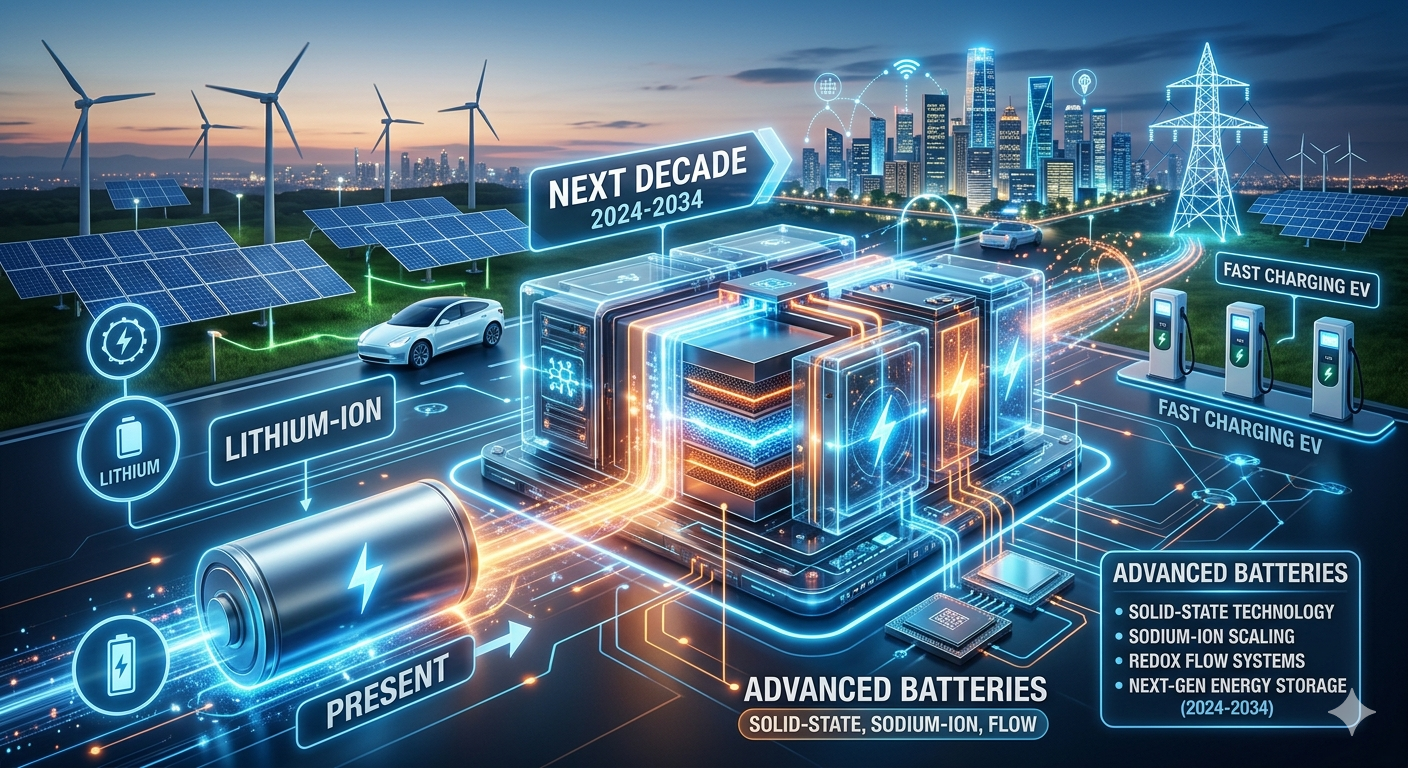
After Lithium: Why Advanced Batteries Will Define the Next Decade of Energy Storage
For the past decade, lithium-ion batteries have powered our devices, vehicles, and even utility-scale storage systems. But the future of energy storage will not be written in lithium alone. As demand for cleaner, scalable, and geopolitically secure energy storage accelerates, a new class of advanced batteries—beyond lithium—is emerging. Solid-state, sodium-ion, lithium-sulfur, and flow batteries are rapidly transitioning from lab curiosity to industrial relevance. Why now? Because current lithium-ion technology, though mature, is nearing its theoretical energy density limits (~300 Wh/kg). Moreover, the global supply of critical minerals like cobalt and nickel is under pressure—both economically and politically. According to recent industry benchmarks, EV-grade lithium carbonate has seen price swings of over 250% in the last 24 months, challenging long-term cost predictability for OEMs. Where Innovation Is Headed Let’s break down three promising contenders poised to redefine the battery landscape: Solid-State Batteries: By replacing flammable liquid electrolytes with solid ceramics or polymers, these batteries promise energy densities >400 Wh/kg and dramatically improved safety. Toyota and QuantumScape are aiming for commercial deployment by 2027. Sodium-Ion Batteries: With zero lithium or cobalt, these batteries are up to 30% cheaper and ideal for grid and stationary storage. CATL began mass production in 2023, targeting 160 Wh/kg with room to grow. Flow Batteries (e.g., Vanadium Redox): While lower in energy density, they offer almost unlimited cycle life and easy scalability—critical for utility-scale storage and peak shaving. Current data suggests that hybrid solutions—such as pairing lithium-ion fast-response cells with flow batteries for long-duration discharge—are gaining traction in grid applications, particularly in regions with high renewable penetration like California and Germany. Key Insights and Market Implications Cost Diversification: Advanced chemistries reduce reliance on constrained mineral supply chains, enhancing global energy security and cost stability. Design Flexibility: Modular chemistries like flow and sodium-ion allow form-factor rethinking—from containerized grid storage to embedded urban infrastructure. Safety and Regulation: Solid-state and aqueous-based systems reduce thermal runaway risks, simplifying compliance and insurance underwriting. Capital Efficiency: Longer lifespans and deeper discharge capabilities improve asset utilization in B2B energy-as-a-service models. According to recent forecasts by BloombergNEF, non-lithium battery technologies could represent up to 25% of stationary energy storage deployments by 2030. That signals a fundamental shift—not just in chemistry, but in the business models and supply chains that underpin the energy economy. For investors, utilities, and OEMs, the implication is clear: Advanced batteries are no longer a “next-gen” concept. They are today’s R&D frontier and tomorrow’s infrastructure. The Industrial Moment Is Now Companies that integrate diversified battery portfolios will gain resilience in both pricing and performance. From decarbonizing logistics fleets to stabilizing intermittent renewables, advanced batteries are the linchpin of a flexible, scalable energy future. The question is no longer if we’ll move beyond lithium—but how fast we’ll get there, and who will lead the charge. What battery innovation do you believe will have the greatest industrial impact by 2030? Join the conversation and share your insights. #EnergyStorage #AdvancedBatteries #SolidState #SodiumIon #BatteryInnovation #GridModernization #CleanTech