


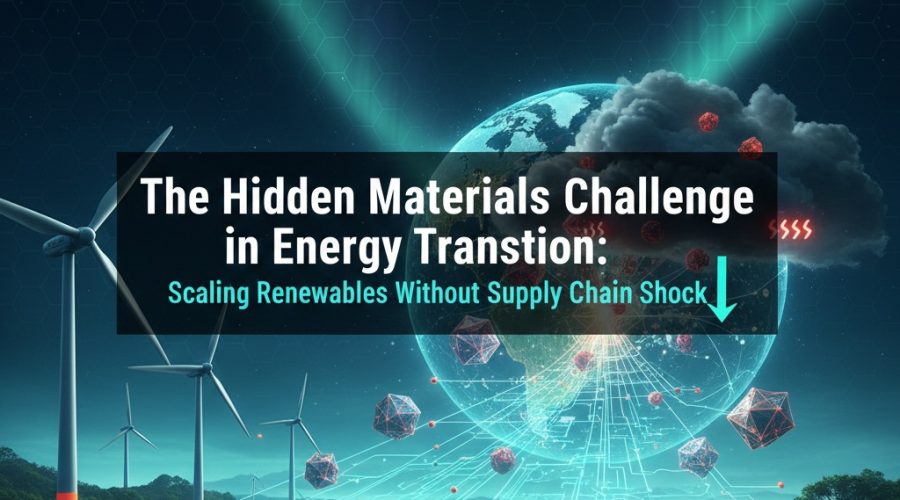
The global push toward a net-zero economy hinges not just on ambitious decarbonization goals—but on the raw materials needed to build the infrastructure behind them. As wind turbines rise, solar farms sprawl, and electric vehicles scale, a silent bottleneck is forming beneath the surface: the availability and refinement of critical materials.
Energy transition isn’t just an engineering or policy challenge—it’s a deep-rooted materials challenge. One that could redefine geopolitical alliances, reshape manufacturing priorities, and determine which economies lead or lag in the next industrial revolution.
The Materials Behind the Megawatts
Renewables and electrification technologies are exponentially more materials-intensive than their fossil-fuel counterparts. According to recent industry benchmarks, an onshore wind plant requires nine times more mineral resources than a gas-fired power plant of similar capacity. EVs demand six times more critical metals than internal combustion engine vehicles, primarily due to lithium-ion batteries.
Key minerals driving this shift include:
- Lithium, cobalt, and nickel – Core to battery energy density and thermal stability.
- Rare earth elements (e.g., neodymium, dysprosium) – Critical for permanent magnets in wind turbines and EV motors.
- Copper – Foundational to all forms of electrification, from transmission lines to smart inverters.
Yet current data suggests that supply chains for these materials are fragile, geographically concentrated, and often environmentally and socially contentious. For example, over 60% of global cobalt supply originates from the Democratic Republic of Congo—frequently under scrutiny for labor practices. Similarly, China controls over 80% of global rare earth refining capacity.
Why Scaling Without Strategy Risks Systemic Shock
The International Energy Agency estimates that by 2040, demand for lithium could grow over 40-fold from 2020 levels. But mining projects typically take 7–10 years from discovery to production. This mismatch between renewable deployment timelines and materials lead times poses a serious risk.
Without proactive diversification and innovation, the renewable energy boom could be slowed—not by lack of technology or capital—but by lack of feedstock. Worse, countries may simply shift energy dependence from oil-rich regions to mineral-rich ones, trading one concentration of risk for another.
Key Insights
- Materials are the new upstream. In the clean energy economy, access to lithium, cobalt, and rare earths will be as strategic as oil and gas once were.
- Geopolitical leverage is shifting. Nations controlling refining and processing infrastructure, not just mines, will hold disproportionate power.
- Circularity will be a growth sector. Recycling and secondary recovery of key materials could become a $100B+ industry by 2040.
- Innovation in substitution is urgent. Research into sodium-ion batteries, silicon-based anodes, and magnet-free motors could reduce dependency on scarce inputs.
- Transparent supply chains will become competitive advantages. OEMs and utilities may soon be audited not just on carbon footprint, but on material provenance and ESG standards.
So What?
For boardrooms and policymakers, this isn’t just an environmental challenge—it’s a strategic imperative. The materials gap, if left unaddressed, could become the Achilles heel of the energy transition. Infrastructure investments, R&D portfolios, and bilateral trade strategies must now account for materials security as rigorously as they do emissions reductions.
De-risking the energy transition means redesigning our supply chains with resilience, sustainability, and technological agility at their core. The future of clean energy won’t be dictated solely by kilowatts—but by kilograms.
What steps is your organization taking to secure critical materials for the net-zero era?
#EnergyTransition #CriticalMinerals #SupplyChainResilience #RenewableEnergy #SustainableManufacturing #MaterialScience #CleanTech