


For the past decade, lithium-ion batteries have powered our devices, vehicles, and even utility-scale storage systems. But the future of energy storage will not be written in lithium alone.
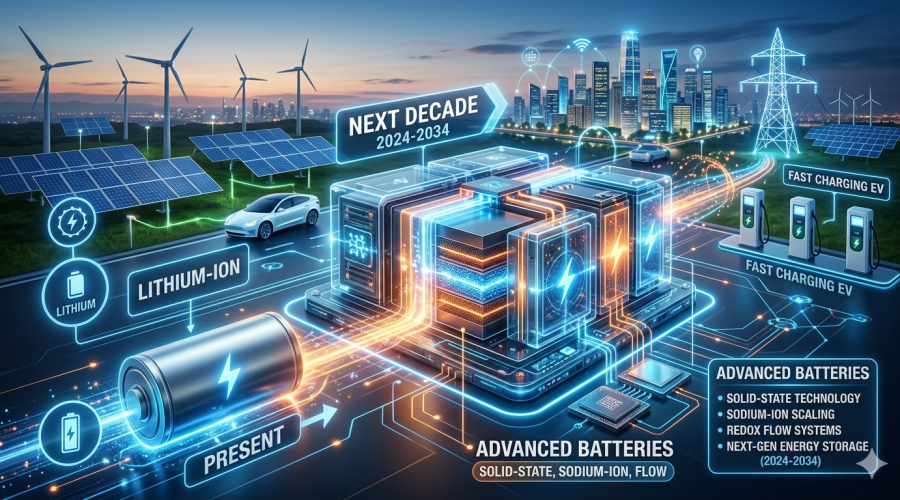
As demand for cleaner, scalable, and geopolitically secure energy storage accelerates, a new class of advanced batteries—beyond lithium—is emerging. Solid-state, sodium-ion, lithium-sulfur, and flow batteries are rapidly transitioning from lab curiosity to industrial relevance.
Why now? Because current lithium-ion technology, though mature, is nearing its theoretical energy density limits (~300 Wh/kg). Moreover, the global supply of critical minerals like cobalt and nickel is under pressure—both economically and politically. According to recent industry benchmarks, EV-grade lithium carbonate has seen price swings of over 250% in the last 24 months, challenging long-term cost predictability for OEMs.
Where Innovation Is Headed
Let’s break down three promising contenders poised to redefine the battery landscape:
- Solid-State Batteries: By replacing flammable liquid electrolytes with solid ceramics or polymers, these batteries promise energy densities >400 Wh/kg and dramatically improved safety. Toyota and QuantumScape are aiming for commercial deployment by 2027.
- Sodium-Ion Batteries: With zero lithium or cobalt, these batteries are up to 30% cheaper and ideal for grid and stationary storage. CATL began mass production in 2023, targeting 160 Wh/kg with room to grow.
- Flow Batteries (e.g., Vanadium Redox): While lower in energy density, they offer almost unlimited cycle life and easy scalability—critical for utility-scale storage and peak shaving.
Current data suggests that hybrid solutions—such as pairing lithium-ion fast-response cells with flow batteries for long-duration discharge—are gaining traction in grid applications, particularly in regions with high renewable penetration like California and Germany.
Key Insights and Market Implications
- Cost Diversification: Advanced chemistries reduce reliance on constrained mineral supply chains, enhancing global energy security and cost stability.
- Design Flexibility: Modular chemistries like flow and sodium-ion allow form-factor rethinking—from containerized grid storage to embedded urban infrastructure.
- Safety and Regulation: Solid-state and aqueous-based systems reduce thermal runaway risks, simplifying compliance and insurance underwriting.
- Capital Efficiency: Longer lifespans and deeper discharge capabilities improve asset utilization in B2B energy-as-a-service models.
According to recent forecasts by BloombergNEF, non-lithium battery technologies could represent up to 25% of stationary energy storage deployments by 2030. That signals a fundamental shift—not just in chemistry, but in the business models and supply chains that underpin the energy economy.
For investors, utilities, and OEMs, the implication is clear: Advanced batteries are no longer a “next-gen” concept. They are today’s R&D frontier and tomorrow’s infrastructure.
The Industrial Moment Is Now
Companies that integrate diversified battery portfolios will gain resilience in both pricing and performance. From decarbonizing logistics fleets to stabilizing intermittent renewables, advanced batteries are the linchpin of a flexible, scalable energy future.
The question is no longer if we’ll move beyond lithium—but how fast we’ll get there, and who will lead the charge.
What battery innovation do you believe will have the greatest industrial impact by 2030? Join the conversation and share your insights.
#EnergyStorage #AdvancedBatteries #SolidState #SodiumIon #BatteryInnovation #GridModernization #CleanTech