


Over the last 18 months, generative AI has moved from an experimental novelty to a strategic pillar across nearly every sector. But what’s next?
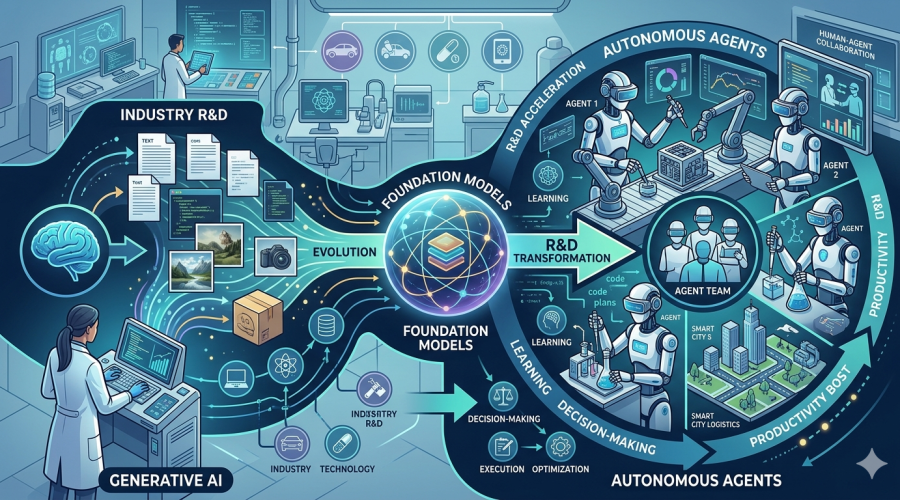
We’re now entering a new phase—where foundation models not only generate insights but autonomously act on them. This shift from passive model outputs to autonomous agents is poised to redefine R&D itself, blurring the lines between ideation, simulation, and execution.
A Shift from Generative to Autonomous
Foundation models like GPT-4 (175B+ parameters) and Gemini 1.5 are already transforming content, code, and conversation. However, their integration into multi-agent systems introduces memory, planning, and tool usage—enabling closed-loop systems that can iteratively improve designs, synthesize experiments, and even file patents.
Autonomous agents are already being tested in domains like chip design, materials discovery, and synthetic biology. Their advantage? Extreme iteration speed and the ability to explore non-intuitive design spaces. In semiconductor R&D, for example, autonomous AI models are helping reduce the design-test-feedback loop from weeks to hours.
Why It Matters for R&D
Current data suggests that up to 40% of R&D spend in high-tech industries is tied to inefficiencies in simulation, prototyping, and testing. Autonomous agents built on foundation models are tackling this head-on.
Consider Intel’s use of generative AI for architecture exploration at advanced process nodes like 3nm and below. These models optimize for power, performance, and area (PPA) trade-offs—compressing decision cycles that once took months. In pharma, generative models paired with autonomous agents are accelerating compound identification and preclinical testing, sometimes by an order of magnitude.
Key Implications
- Increased Throughput: Autonomous agents can run thousands of simulations in parallel, dramatically increasing iteration speed across industries.
- Cost Reduction: AI-driven R&D workflows reduce reliance on expensive physical prototyping and lab testing.
- Democratization of Expertise: Foundation models embedded with domain-specific knowledge lower the barrier for non-experts to contribute to high-stakes innovation.
- IP Acceleration: Some labs report autonomous systems generating novel patentable ideas, potentially shifting the pace and ownership of intellectual property.
- Talent Strategy Reboot: R&D organizations must now prioritize prompt engineering, model fine-tuning, and agent orchestration as core competencies.
Economic Impact
According to recent industry benchmarks, organizations piloting autonomous R&D agents in sectors like semiconductors, aerospace, and chemicals are realizing up to 30% faster time-to-market. In multi-billion dollar markets, that translates to billions in potential value capture—and a new competitive frontier defined not just by human talent, but by how well your AI agents perform.
In many ways, we’re witnessing the industrialization of cognition. Foundation models are no longer just tools—they’re becoming co-workers. The next S-curve in productivity may not come from automation alone, but from AI that can think, reason, and act across the full innovation lifecycle.
What’s Next?
As we move from reactive models to proactive agents, the real question is no longer “What can AI do?” but “What should we allow AI to decide?”
How will industries govern this new class of autonomous collaborators?
#FoundationModels #AutonomousAgents #R&DInnovation #GenerativeAI #Semiconductors #FutureofWork #AIinIndustry