



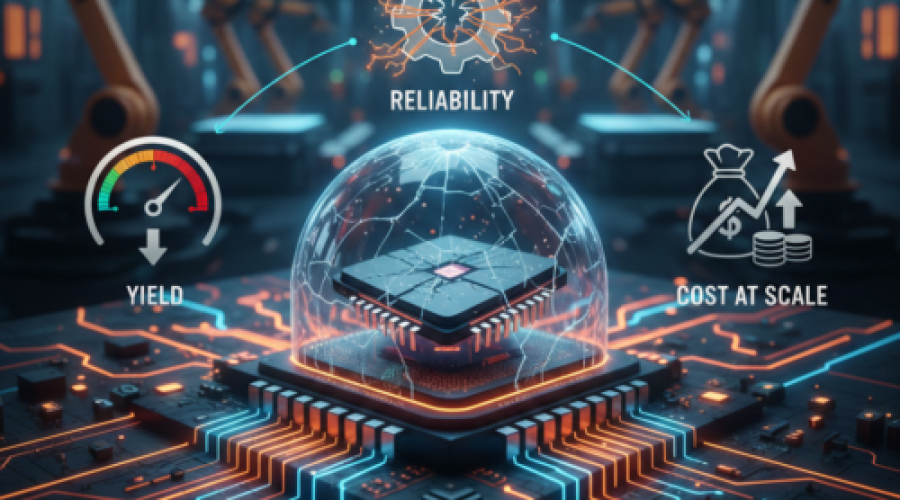
The Real Bottleneck in Advanced Semiconductors: Yield, Reliability, and Cost at Scale
As the semiconductor industry races toward sub-3nm nodes and heterogeneous integration, attention often gravitates toward breakthrough transistor architectures, extreme ultraviolet (EUV) lithography, or AI-specific chip designs. But those watching only the front-end innovations may be missing the real bottleneck: yield, reliability, and cost at scale.
At 3nm and below, every part of the manufacturing chain—from mask complexity to process variability—introduces exponentially greater risk. And while the headlines celebrate smaller transistors and faster chips, the hard truth is this: producing those chips reliably and affordably, in volume, is the true challenge.
Why Yield and Reliability Have Become the Battlefield
In the 28nm era, process maturity meant yields regularly exceeded 90%. Fast forward to 5nm and below, and even industry leaders are grappling with yields in the 50–70% range for complex SoCs. At 3nm, with GAA (Gate-All-Around) structures and increased parasitic coupling, variability becomes a nanoscopic minefield. A minor process deviation can scrap entire wafers.
Current data suggests that the cost per good die at 3nm is nearly 50% higher than at 5nm—not due to raw fab costs alone, but because of lower yields and increased post-processing requirements. And with advanced packaging (e.g., 2.5D, 3D HBM stacks), the failure rate compounds across the system level.
The Reliability Conundrum
As chips shrink, their susceptibility to electromigration, soft errors, and thermal hotspots rises. Reliability isn’t just a concern for automotive or aerospace anymore—it now affects AI data centers, where downtime directly translates to multimillion-dollar losses.
According to recent industry benchmarks, AI accelerators running large transformer models (100B+ parameters) require sustained uptime to justify TCO. Even a 0.1% drop in reliability across tens of thousands of GPUs can result in delays and lost inference throughput—undermining SLAs for hyperscalers.
The Cost Scaling Myth
Moore’s Law promised cost-per-transistor reductions with each node shrink. That promise is cracking. While transistor densities are indeed increasing, the cost per die isn’t falling in step. In fact, the average wafer cost at 3nm is estimated to be 30–40% higher than at 5nm—before accounting for yield losses.
This shifts the economic calculus: is performance-per-watt still worth the massive capex and yield risk? For some workloads—like high-throughput AI training—the answer may still be yes. But for many edge and consumer applications, older nodes with improved packaging might deliver better ROI.
Key Insights
- Yield degradation at advanced nodes (3nm and below) is becoming the dominant cost factor—more than raw wafer pricing or EUV capex.
- Reliability risks now affect not just safety-critical systems, but AI data centers operating at hyperscale intensity.
- Advanced packaging introduces new failure points, compounding cost and complexity at the system level.
- Economic scaling is diverging from transistor scaling—raising tough questions for system architects and CFOs alike.
- Legacy nodes with better packaging may outperform bleeding-edge nodes in cost-sensitive or thermally constrained applications.
Market Implications
Companies betting on AI accelerators, HPC chips, or next-gen mobile SoCs must now factor not just PPA (power, performance, area)—but YRC: Yield, Reliability, and Cost.
For foundries, this creates a bifurcation: high-value customers will absorb the costs of advanced nodes, but a growing segment of the market may revert to N+1 or N+2 nodes with innovative chiplet designs. TSMC’s 6nm and 7nm lines remain in high demand for this reason.
For system designers, the focus shifts from just “what node?” to “what architecture, packaging, and yield model delivers the best ROI?” Engineering excellence must now extend into manufacturing science and supply chain economics.
Looking Ahead
The semiconductor narrative is evolving. It’s no longer just about nanometers—it’s about predictability, durability, and economic viability at scale. As we design chips to power trillion-parameter AI models and autonomous systems, we must also design for manufacturability and reliability at global scale.
What if the real innovation in semiconductors isn’t at 2nm—but in how we better scale 7nm with smarter yield strategies and reliability engineering?