


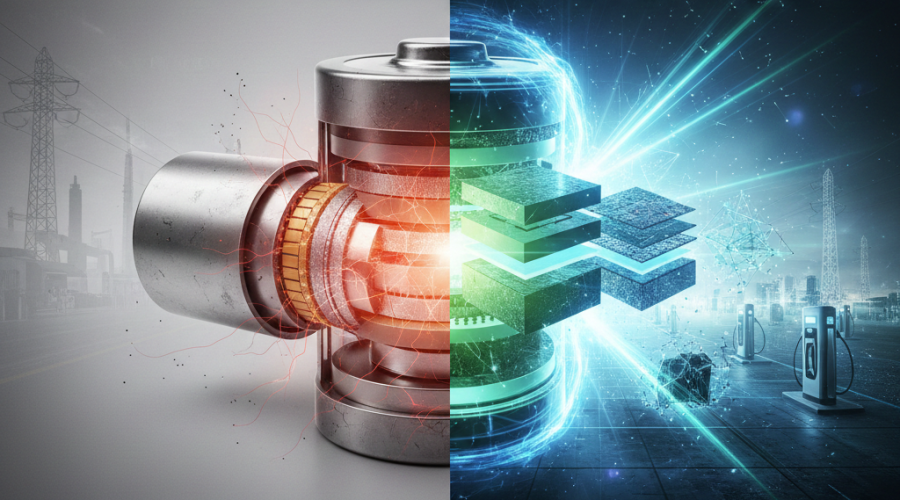
The lithium-ion battery has been the cornerstone of the mobile revolution—powering everything from smartphones to EVs. But the era of lithium dominance is reaching its limits. Supply constraints, safety concerns, and performance ceilings have opened the door for new chemistries and architectures to redefine what’s possible in energy storage.
Across labs and industries, the race is on. Solid-state, sodium-ion, lithium-sulfur, and metal-air batteries are no longer distant dreams. They are materializing into commercial realities—bringing with them the potential to reshape the economics of energy, transform national security strategies, and enable the next wave of electrification at the grid scale.
The Limits of Lithium-Ion
While lithium-ion batteries (LIBs) have seen remarkable improvements in energy density and cost reductions—falling from $1,200 per kWh to under $150 per kWh in the last decade—there are fundamental limits that cannot be engineered away. Current data suggests that LIBs are approaching their theoretical energy density ceiling (~300 Wh/kg), and incremental gains are becoming harder and more expensive to achieve.
Moreover, lithium’s geopolitical complexity is intensifying. According to recent industry benchmarks, over 60% of lithium refining capacity is concentrated in China, presenting vulnerabilities for markets dependent on secure battery supply chains. Cobalt and nickel, often used in LIB cathodes, pose similar risks—both in ethical sourcing and pricing volatility.
Emerging Chemistries: What’s Next?
Here’s a breakdown of the most promising post-lithium contenders:
- Solid-State Batteries (SSBs): By replacing flammable liquid electrolytes with solid materials, SSBs can potentially double energy density (~500 Wh/kg) while improving safety and charge cycles. Toyota and QuantumScape aim for commercial deployment by 2025–2026.
- Sodium-Ion: Utilizing abundant sodium instead of scarce lithium, this chemistry offers lower energy density (~160 Wh/kg) but significant cost and sustainability advantages. CATL and Faradion are investing heavily in scaling production.
- Lithium-Sulfur (Li-S): Featuring theoretical energy densities approaching 600 Wh/kg, Li-S batteries avoid cobalt entirely. However, cycle life and sulfur’s instability remain key engineering challenges.
- Metal-Air (e.g., Zinc-Air, Aluminum-Air): These systems boast ultra-high theoretical energy densities, making them attractive for grid storage. Current data suggests commercialization is still 5–10 years out, due to reversibility and degradation issues.
Each of these technologies represents a tradeoff—between energy density, cost, cycle life, and manufacturability. But the overarching trend is clear: we are moving toward a more diversified battery landscape, optimized for use-case rather than a one-size-fits-all approach.
Architectural Shifts and Manufacturing Scalability
It’s not just about new chemistries. The architecture of battery cells—pouch vs. prismatic, anode-free designs, 3D current collectors—is evolving rapidly. Startups like Sila Nanotechnologies and Group14 are deploying silicon-dominant anodes to boost capacity without overhauling OEM lines. Simultaneously, dry-electrode manufacturing (pioneered by companies like Tesla and Maxwell Technologies) promises to cut energy use during production by up to 90%.
Scalability remains the bottleneck. According to recent industry benchmarks, less than 5% of global battery production capacity is currently geared for anything other than lithium-ion. That means billions in retooling—and a multi-year ramp-up—before alternatives can compete at scale. However, policy tailwinds like the U.S. Inflation Reduction Act and the EU Battery Regulation are accelerating this transition.
Key Market Implications
- Energy storage will decouple from lithium supply chains—reducing geopolitical risk and enabling regional manufacturing hubs.
- EV cost parity could arrive earlier as sodium-ion and lithium-sulfur solutions enter volume production, especially in price-sensitive markets like India and Southeast Asia.
- Grid-scale storage will finally scale as metal-air and aqueous batteries deliver long-duration storage at <$50/kWh.
- Battery-as-a-service models will emerge as longer-lasting chemistries reduce degradation and extend operational lifetimes.
- Venture capital and strategic investment will shift toward vertically integrated battery platforms and novel recycling methods.
The Economic Stakes
The battery industry is expected to exceed $400 billion by 2030, according to BloombergNEF. But beyond size, it’s the strategic leverage that matters. Advanced batteries will dictate who controls the clean energy transition—who builds the next Tesla, who dominates grid storage, who maintains digital sovereignty as AI and edge computing become increasingly mobile.
For energy companies, automakers, and even cloud providers, batteries are no longer a component. They are a strategic fulcrum.
Conclusion
We are standing at the edge of a new battery paradigm—where the question is no longer “How do we improve lithium-ion?” but “What comes after it?” The answers will determine not only who leads in energy and mobility but who wins the broader industrial game over the next decade.
What’s your take—will advanced batteries disrupt the energy status quo faster than we expect, or will lithium remain the incumbent for longer than most forecasts suggest?