


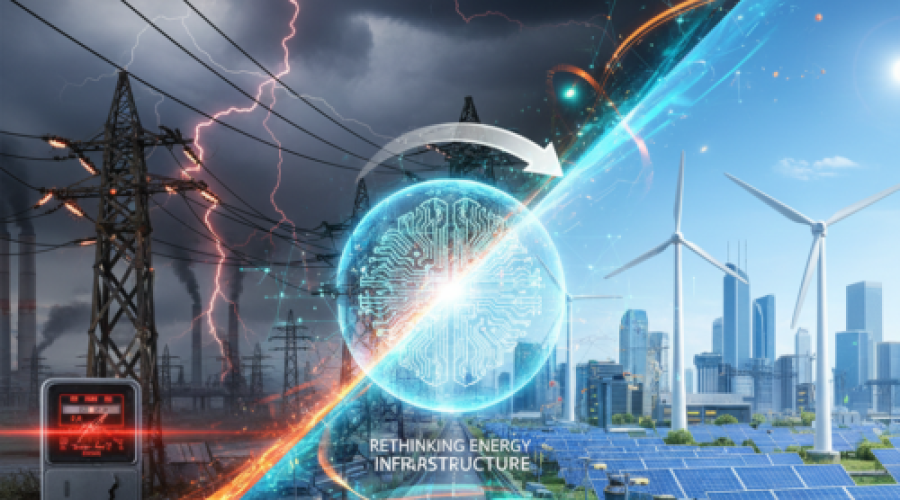
The energy transition is no longer a distant goal—it’s a present imperative. As the share of solar, wind, and other intermittent renewables on the grid grows, utilities and grid operators are navigating an increasingly complex, volatile, and decentralized energy landscape. What’s at stake? Not just reliability, but the future of energy economics itself.
Traditional grids were built for unidirectional power flow: large centralized plants generating electricity, which flows to passive consumers. That model is breaking down. Now, millions of distributed energy resources (DERs)—from rooftop solar to EV chargers—are pushing power back into the grid. This bidirectional flow is making the grid behave more like a dynamic network than a linear system.
According to recent industry benchmarks, in regions like California and parts of Europe, renewables already contribute more than 30% of total electricity generation annually. On some days, they exceed 100% of instantaneous demand. While this marks a win for sustainability, it introduces unprecedented stress on infrastructure designed decades ago.
The Case for Grid Intelligence
To orchestrate an increasingly complex supply-demand equation, utilities are embracing a new paradigm: grid intelligence. This is not simply about adding sensors or analytics layers—it’s about re-architecting the grid with AI, edge computing, and real-time control systems.
Modern intelligent grids incorporate:
- Advanced Distribution Management Systems (ADMS): Integrating DERs in real-time with predictive analytics to forecast load and generation.
- Latency-optimized edge computing: Managing microgrid operations and resilience locally, with sub-100ms response times.
- AI-based forecasting algorithms: Leveraging weather, consumption, and historical data to anticipate load patterns and renewable availability.
- Solid-state transformers: Offering voltage control and bidirectional power flow for managing variable energy inputs.
- Grid-forming inverters: Enabling renewables to provide synthetic inertia and enhance grid stability.
The Semiconductor Backbone
Grid intelligence is not just a software problem—it’s a hardware challenge too. Semiconductors are playing a pivotal role in the energy transition. Power-efficient chips at 7nm and below are powering real-time analytics at the grid edge, while wide-bandgap materials like SiC and GaN are driving high-efficiency power conversion in inverters and EV chargers.
Current data suggests that the market for power semiconductors in energy infrastructure will surpass $10B by 2026. This is catalyzing innovation across the supply chain—from chip architecture to thermal management systems and new packaging standards.
Key Insights
- Legacy grid architecture is fundamentally incompatible with high-penetration renewables.
- Grid intelligence enables real-time responsiveness, resilience, and economic optimization of energy flows.
- AI and edge computing are critical for managing the volatility introduced by DERs.
- Semiconductor innovation is essential to enable low-latency, high-efficiency energy systems.
- Utilities that fail to invest in grid intelligence risk escalating O&M costs and systemic instability.
So What?
The industrial implications are profound. Grid modernization is not just a technical upgrade—it’s a competitive necessity. Utilities that adopt intelligent infrastructure will not only ensure grid reliability but also unlock new revenue streams through demand response, flexible pricing, and energy-as-a-service models. Conversely, those that fail to adapt risk stranded assets and regulatory penalties.
Investors, OEMs, and policymakers should be watching closely. The next decade will determine whether today’s grid stress becomes tomorrow’s crisis—or catalyst.
Are we ready to move from grid resilience as a reaction, to grid intelligence as a strategy?
#GridIntelligence #RenewableEnergy #EnergyTransition #SmartGrid #PowerSemiconductors #CleanTech #InfrastructureInnovation